
Checklists · All checklists · Updated Oct 22, 2026
New fence installer first-week checklist
A day-by-day plan for a new hand's first week on a fence crew: safety and gear, tools and the auger, locate marks and layout, setting posts and gates, and a clean closeout. Each day has a short list the crew lead checks off, and a printable card with a sign-off table sits at the bottom.

How to use this list
The crew lead owns it. Each line is either shown, done with help, or done alone, and the card at the bottom tracks which. The order matters more than the exact day: safety and gear before tools, locates before the first hole, and closeout before anyone calls the job done. If a week is rained out or the jobs do not fit, slide the days. Do not skip them.
This list does not replace the training your state, your insurer, or a specific OSHA standard requires, the manufacturer's installation instructions for the products you build, or the operating manuals for your machines. It is a floor, not a ceiling.
Before day one: Office and crew lead
- Pick the crew lead the new hire rides with all week. The steadiest lead, not the fastest.
- Paperwork ready: payroll and tax forms and Form I-9 (see day-one paperwork on AI Fence HQ).
- Protective gear set aside in their size: gloves, safety glasses, hearing protection, and any hard hat or vest your jobs call for.
- Pick first-week jobs that suit training: simple layouts, good access, locate tickets already clear for the dig dates.
- If the forecast is hot, plan the heat ramp-up (rule of 20 percent, below) before they show up.
- Print this page's first-week card and put it in the crew lead's folder.
Day 1: Safety, gear, and the truck
- Who to call if someone is hurt, where the nearest urgent care is, and where the first aid kit lives on the truck.
- How to report an injury, a close call, or a hazard, and that reporting will not get them in trouble.
- Fit every piece of protective gear. Show when each is needed, how to put it on and adjust it, and its limits.
- Water, rest, and shade: where the cooler is, when breaks happen, and that nobody skips one to look tough.
- Truck and trailer walk-around: where tools ride, how material is strapped, and who drives.
- On the job: carry, stage, and clean up. Watch the lead pull the line and lay out posts. Stay out of the auger's swing.
OSHA's training guidance says every worker should learn how to report injuries, illnesses, hazards, and close calls, what to do in an emergency, and that they can report without fear of retaliation. It also says training should be in a language and at a reading level each worker understands, and that on-the-job, peer-to-peer, and job-site demonstrations can work as well as a classroom. That is how fence crews teach anyway; the list just makes sure nothing gets skipped.
On gear, OSHA says employers must train each worker who needs protective equipment on when it is necessary, what kind, how to put it on, adjust, wear, and take it off, its limits, and its care and useful life. Gear that does not fit does not get worn, so fit it on day one.
Day 2: Tools and the dig
- Hand tools first: post hole digger, digging bar, shovel, tamper, level, string line, tape. Care and where each one goes back.
- Power tools: cords and batteries checked before use, guards stay on, unplug or pull the battery to change a blade or bit.
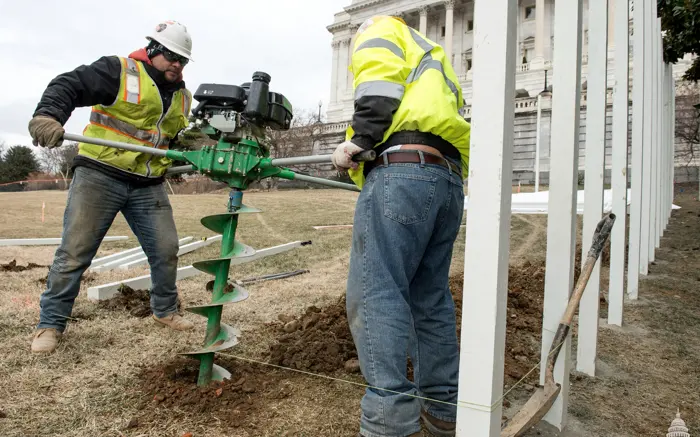
- Auger: who runs it, where everyone else stands, what to do when it binds on a root or rock. Watch and spot before running it.
- Hearing protection on for the auger, saws, and anything that makes you raise your voice to talk at arm's length.
- Dig and set with a partner. Check hole depth against the plan, not by eye.
- Mix and pour concrete the way the job's spec or the manufacturer's instructions say.
OSHA's noise page gives a simple field test: if you have to raise your voice to talk to someone about 3 feet away, the noise might be over 85 decibels, and OSHA says exposure over 85 decibels can damage your hearing. Augers, saws, and gas mixers are the usual suspects on a fence job. Hearing loss from noise is permanent, so plugs or muffs go in before the engine starts, not after.
For power tools, OSHA's hand and power tool pages are the reference for guards, cords, and safe use. The tool and auger manufacturers' operating manuals decide the rest. Read them with the new hire for the machines they will touch.
Day 3: Locates and layout
- Read the locate ticket on the job folder: ticket number, legal start date, expiration, and which utilities responded.
- Learn the paint and flag colors (table below) and that white means the planned dig area, marked by the contractor.
- Hand dig inside the tolerance zone. Never run the auger on top of or next to a mark.
- Marks missing, faded, or not matching the ticket: stop and call the crew lead. No dig.
- Pull a string line, measure post spacing from the drawing, and check the layout against the plan before the first hole.
- Ask the homeowner-side question every time: sprinklers, lighting, invisible dog fence, power to a shed. 811 usually does not mark private lines.
The Common Ground Alliance (CGA), the national damage-prevention association that publishes the 811 Best Practices, adopts the APWA uniform color code nationwide. State 811 centers publish the same chart; the one below follows the Missouri 811 excavator page. Your state can add rules, so check your own one-call center.
| Color | What it marks |
|---|---|
| White | Proposed excavation (the dig area the contractor marks) |
| Pink | Temporary survey markings |
| Red | Electric power lines, cables, conduit, and lighting cables |
| Yellow | Gas, oil, steam, petroleum, or gaseous materials |
| Orange | Communication, alarm or signal lines, cables, or conduit |
| Blue | Potable water |
| Purple | Reclaimed water, irrigation, and slurry lines |
| Green | Sewers and drain lines |
CGA's best practice is a tolerance zone of the width of the line plus 18 inches on either side of its outside edge, unless your state sets a wider one. Inside that zone, dig by hand or with other careful methods your state allows. CGA also recommends white lining: marking the planned dig area in white paint, flags, or stakes, or electronically where the 811 center offers it, so locators mark the right place. The office side of locates, including ticket life and renewals, is on the 811 locate checklist.
Day 4: Posts, infill, and gates
- Set posts plumb and in line. Check with a level on two faces before the concrete sets.
- Follow the manufacturer's installation instructions for post spacing, depth, and footings. Not a habit from another product.
- Hang rails, pickets, panels, or fabric with a partner. Clean cuts, fasteners rated for the material.
- Watch a gate get hung: gate post, hinges, latch, drop rod. Learn why gate posts get extra care.
- Handle cut lumber, treated wood, and metal edges with gloves on. Sweep cutoffs as you go.
- Lift with a partner on panels, gates, and full concrete bags. Ask before carrying anything awkward alone.
Day 5: Closeout and the sign-off
- Open and close every gate through its full swing. Check latches, hinges, and drop rods.
- Clean up: spoils spread or hauled per the job, cutoffs and loose fasteners picked up, magnet sweep where kids or pets play.
- After photos: each run, every gate open and closed, the cleaned work area.
- Walk the line with the crew lead, then the homeowner. Anything off goes on the punch list.
- Sit down with the crew lead: what was hard, what to learn next, what to repeat in week two.
- Sign off the card below. Keep it in the employee file. Unchecked lines carry into week two.
The gate and closeout lines come straight from the gate hardware and closeout checklists. A new hire who learns them in week one is the crew lead who runs them later.
If the week is hot: ramp up the hours
OSHA reports that almost half of heat-related deaths happen on a worker's first day on the job and over 70 percent in the first week. OSHA and NIOSH recommend the rule of 20 percent: on day one a new worker spends no more than 20 percent of the normal time in the heat, then adds 20 percent each day. On an 8-hour day that is no more than 1 hour 40 minutes of hot work on day one. OSHA also says to give new workers more breaks, train them on heat illness symptoms, watch them closely, use a buddy system, never let them work alone, and keep the extra care for 1 to 2 weeks.
OSHA's guidance is to cut the time in the heat, not the intensity of the work, so the body adapts to the real job. On a fence crew that can mean digging in the cool morning and doing shaded work like sorting hardware or prepping gates in the afternoon. For water, OSHA says to drink often, not only when thirsty, and to have electrolyte drinks on hand for work lasting more than two hours.
OSHA 10: useful, not a substitute
OSHA's Outreach Training Program offers 10-hour and 30-hour classes from OSHA-authorized trainers, with a completion card at the end. OSHA says the 10-hour class gives workers awareness of common hazards, and the 30-hour class suits supervisors. OSHA is also clear that the program is voluntary, is not a certification, and does not meet the training requirements of any specific OSHA standard. Some states, cities, and general contractors require the card, so check before you bid commercial work. Either way, the job-specific training on this page still falls on the shop.
Printable
Printable first-week card
For the crew lead's folder. Mark each line S (shown), H (did with help), or A (did alone), and initial it.
Before day one: Office and crew lead
- Pick the crew lead the new hire rides with all week. The steadiest lead, not the fastest.
- Paperwork ready: payroll and tax forms and Form I-9 (see day-one paperwork on AI Fence HQ).
- Protective gear set aside in their size: gloves, safety glasses, hearing protection, and any hard hat or vest your jobs call for.
- Pick first-week jobs that suit training: simple layouts, good access, locate tickets already clear for the dig dates.
Day 1: Safety, gear, and the truck
- Who to call if someone is hurt, where the nearest urgent care is, and where the first aid kit lives on the truck.
- How to report an injury, a close call, or a hazard, and that reporting will not get them in trouble.
- Fit every piece of protective gear. Show when each is needed, how to put it on and adjust it, and its limits.
- Water, rest, and shade: where the cooler is, when breaks happen, and that nobody skips one to look tough.
Day 2: Tools and the dig
- Hand tools first: post hole digger, digging bar, shovel, tamper, level, string line, tape. Care and where each one goes back.
- Power tools: cords and batteries checked before use, guards stay on, unplug or pull the battery to change a blade or bit.
- Auger: who runs it, where everyone else stands, what to do when it binds on a root or rock. Watch and spot before running it.
- Hearing protection on for the auger, saws, and anything that makes you raise your voice to talk at arm's length.
Day 3: Locates and layout
- Read the locate ticket on the job folder: ticket number, legal start date, expiration, and which utilities responded.
- Learn the paint and flag colors and that white means the planned dig area, marked by the contractor.
- Hand dig inside the tolerance zone. Never run the auger on top of or next to a mark.
- Marks missing, faded, or not matching the ticket: stop and call the crew lead. No dig.
Day 4: Posts, infill, and gates
- Set posts plumb and in line. Check with a level on two faces before the concrete sets.
- Follow the manufacturer's installation instructions for post spacing, depth, and footings. Not a habit from another product.
- Hang rails, pickets, panels, or fabric with a partner. Clean cuts, fasteners rated for the material.
- Watch a gate get hung: gate post, hinges, latch, drop rod. Learn why gate posts get extra care.
Day 5: Closeout and the sign-off
- Open and close every gate through its full swing. Check latches, hinges, and drop rods.
- Clean up: spoils spread or hauled per the job, cutoffs and loose fasteners picked up, magnet sweep where kids or pets play.
- After photos: each run, every gate open and closed, the cleaned work area.
- Walk the line with the crew lead, then the homeowner. Anything off goes on the punch list.
Sign-off
| Skill | S / H / A | Date | Lead initials |
|---|---|---|---|
| Protective gear: fits, knows when to wear each piece | |||
| Knows who to call and how to report an injury or close call | |||
| Takes water and rest breaks without being told | |||
| Hand tools: uses, cares for, and stows them | |||
| Auger: trained on the machine, knows where to stand | |||
| Reads the locate ticket and the paint and flag colors | |||
| Stops and calls when marks are missing or wrong | |||
| Pulls a string line and lays out posts from the plan | |||
| Sets a post plumb and in line | |||
| Hangs infill with a partner; helps hang a gate | |||
| Closeout: gate check, cleanup, after photos |
Where AI helps
A chat assistant is handy for the paperwork around this list: turning it into your shop's version, drafting a translation for a bilingual check, or writing a short daily recap for the office. It does not decide who is ready to run a machine. The crew lead does.
Here is a first-week checklist for a new fence installer: [paste the list].
Here is how our shop works (do not add anything else): [fence types we build, machines we run, our start time, who trains, any state rules we follow].
Rewrite the checklist for our shop. Keep the order: safety and gear, tools, locates and layout, posts and gates, closeout.
Do not add pay, legal requirements, depths, spacing, or code rules I did not give you. If something is missing, ask me.
Then draft a Spanish version for a bilingual crew member to check before we use it.
Common questions
What should a new fence installer learn in the first week?
Safety first: protective gear and how to wear it, who to call if someone is hurt, heat and water rules, and where to stand around the auger and saws. Then locate marks and the dig area, layout with a string line, setting posts to the manufacturer's instructions, hanging infill and gates with a partner, and a clean closeout. The day-by-day list on this page puts those in order.
Does a new fence installer need an OSHA 10 card?
Not under federal OSHA rules. OSHA says its 10-hour and 30-hour Outreach classes are voluntary awareness training, not a certification, and do not by themselves meet the training requirements in specific OSHA standards. Some states, cities, or general contractors do require the card, so check your state and your commercial customers. Either way, the employer still trains each worker on the hazards of their own job.
How much should a new installer work in the heat on day one?
OSHA and NIOSH recommend the rule of 20 percent: no more than 20 percent of the normal time in the heat on the first day, adding 20 percent each day after. On an 8-hour day that is no more than 1 hour 40 minutes of hot work on day one. OSHA says the extra precautions should last 1 to 2 weeks.
Should a new hire run the auger in the first week?
That is the crew lead's call, and only after training on that machine and the manufacturer's operating instructions. A common plan is to have the new hire watch, stage, and spot first, then run it with a trained partner beside them. They should never run it near locate marks or inside the tolerance zone.
Can I use AI to translate this checklist for my crew?
As a first draft, yes. OSHA's training guidance says training should be in a language and at a reading level every worker understands. Have a person who speaks both languages check the translation before anyone relies on it, and keep the safety wording plain.
Sources (dated)
- OSHA, Heat: Protecting New Workers, checked Oct 22, 2026: share of heat deaths on day one and in week one (citing Tustin 2018), rule of 20 percent, buddy system, 1 to 2 weeks of extra precautions, reduce duration not intensity.
- OSHA, Heat: Water. Rest. Shade., checked Oct 22, 2026: drink frequently, electrolyte drinks for work over two hours, required breaks as heat stress rises.
- OSHA, Recommended Practices: Education and Training, checked Oct 22, 2026: reporting injuries and close calls, emergencies, no retaliation, language and literacy, on-the-job and peer training.
- OSHA, Personal Protective Equipment, checked Oct 22, 2026: fit, and training on when, what kind, how to wear, limits, and care.
- OSHA, Occupational Noise Exposure, checked Oct 22, 2026: 85 decibel damage threshold, raised-voice-at-3-feet test, permanent hearing loss.
- OSHA, Outreach Training Program, checked Oct 22, 2026: 10-hour and 30-hour classes, voluntary, not a certification, does not meet standard-specific training.
- OSHA, Hand and Power Tools, checked Oct 22, 2026.
- Common Ground Alliance Best Practices, Uniform Color Code (Practice Statement 4-3), Tolerance Zone (5-19), and Delineate Area of Proposed Excavation (5.2, white lining), checked Oct 22, 2026.
- Missouri 811, Excavators, checked Oct 22, 2026: APWA color list and the notify, mark, and confirm process (an example state page; rules vary by state).
Related
- Fence contractor checklists: intake, site visit, gates, closeout
- 811 locates: the fence crew checklist
- Crew ops: mornings, end-of-day notes, safety
- Fence material takeoff checklist
- Hiring fence installers: job posts, ride-alongs, the first two weeks (HQ)
- AI crew planning for fence installs (HQ)
- 811 dig ticket workflow (HQ)